







Learn here whether you should contact the consulate or the embassy if you are outside of Brazil.
Learn here whether you should contact the consulate or the embassy if you are outside of Brazil, avoiding scheduling errors and delays in the visa process.

Em 18 de agosto de 2026 às 01h27
Compartilhe com outras pessoas:


 Clique e navegue pelo artigo:
- ❓What is the difference between an embassy and a consulate?
- ⚖️ What is an embassy?
- What is the purpose of an embassy?
- 🛂What is a Consulate for?
- 📚In-Depth Knowledge - Jessica Serian's Specialization in International Immigration Law
- 🌎 And what does the ambassador do?
- ⁉️Why do foreigners use notary services?
- ⁉️e-Consular, what is it?
- ⁉️Who works at the Embassy?
- ⁉️What is consular jurisdiction?
- 🛂Difference between an embassy and a consulate for US visas
- 🌎 Want to start your process with more confidence?
Nesse artigo você encontra:
- ❓What is the difference between an embassy and a consulate?
- ⚖️ What is an embassy?
- What is the purpose of an embassy?
- 🛂What is a Consulate for?
- 📚In-Depth Knowledge - Jessica Serian's Specialization in International Immigration Law
- 🌎 And what does the ambassador do?
- ⁉️Why do foreigners use notary services?
- ⁉️e-Consular, what is it?
- ⁉️Who works at the Embassy?
- ⁉️What is consular jurisdiction?
- 🛂Difference between an embassy and a consulate for US visas
- 🌎 Want to start your process with more confidence?
❓What is the difference between an embassy and a consulate?
You've probably heard of embassies and consulates , especially when you started researching visas, international travel, or documentation abroad.
But there is a very common question:
Are an embassy and a consulate the same thing?
No. I'm here to tell you that they are not the same thing. The good news is that understanding the difference between an embassy and a consulate is simpler than it seems.
Although both are part of a country's official representation abroad, their functions are different. And we at Serian Vistos will explain the difference between them here in a simple and objective way:
- Embassy: primarily acts in diplomatic relations between governments.
- Consulate: primarily provides consular services and assistance to citizens and foreigners.
That's the general rule. However, there's an important distinction: an embassy may have a consular section and perform certain consular services . Therefore, it's incorrect to assume that every visa issue will necessarily be resolved in a building called a "consulate."
And that's precisely where many people get confused.
If you are researching the difference between an embassy and a consulate because you need to get a visa , continue reading this article, becauseunderstand this differenceThis can prevent unnecessary travel, incorrect scheduling, and wasted time.
⚖️ What is an embassy?
What is the purpose of an embassy?
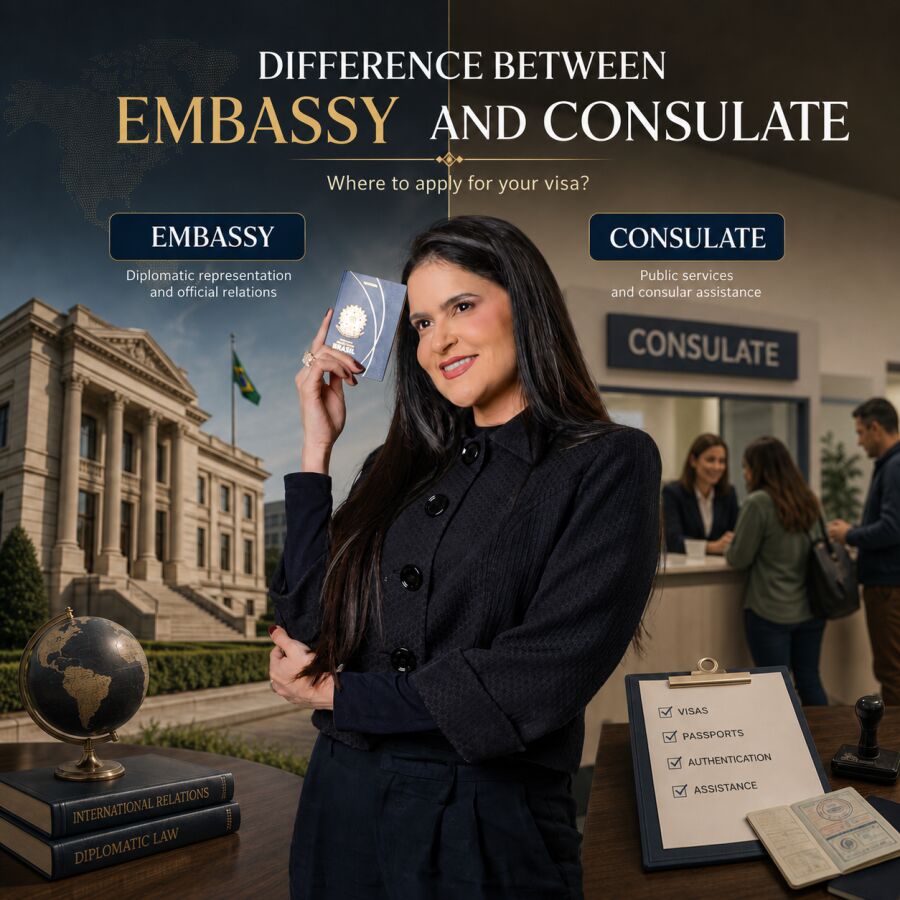
An embassy is the main diplomatic representation of a country in another territory. It is usually located in the capital of the host country and is headed by an ambassador. Its main function is to represent the government of the host country and maintain diplomatic relations with the local government.
Its role is primarily linked to the political, economic, cultural, and diplomatic relations between the two governments.
In practical terms, the embassy acts on issues such as:
- diplomatic relations;
- negotiations between governments;
- international cooperation;
- economic and commercial relations;
- political issues;
- cultural matters;
- official representation of the country.
Therefore, it is common to find the embassy in the capital of the country where it is located .
In Brazil, for example, Brasília concentrates a large portion of foreign diplomatic representations.
What is the purpose of an embassy?
Embassies perform functions focused on diplomatic relations between countries. They work to promote culture, sports, trade and business relations, as well as political and economic negotiations.
They may occasionally offer consular services, such as issuing documents or civil registrations, but this is not their primary function—these services are usually limited and administrative.
What are the functions of an embassy?
The embassy has several responsibilities, however, the main ones are:
- To officially represent a country before another government;
- To participate in diplomatic negotiations;
- To monitor political and economic relations;
- To promote cultural and institutional cooperation;
- To support trade and international relations;
- To coordinate specific diplomatic activities;
- To provide guidance on consular matters, when a specific department exists.
The embassy may also have a consular section. Therefore, in some countries, certain visa or document processing services can be carried out at the embassy itself.
However, its main role remains diplomatic and institutional.
🛂What is a Consulate for?
Consulates focus on providing direct assistance to Brazilian citizens abroad. They offer services such as:
- Issuance and renewal of passports;
- Birth, marriage, and death registration;
- Authentication of documents and powers of attorney;
- Support for Brazilians in emergencies, such as arrests or hospitalizations;
- Visa analysis for foreigners wishing to travel to Brazil;
- Legal and administrative matters involving Brazilian citizens. Consulates are located in cities with a larger number of Brazilian residents, outside the capital, and are headed by consuls, who may be general, deputy, or honorary, depending on the size of the unit.
Consulates are located in cities with a larger number of Brazilian residents, outside the capital, and are headed by consuls, who may be general, deputy, or honorary, depending on the size of the unit.
📚In-Depth Knowledge - Jessica Serian's Specialization in International Immigration Law
The main function of an embassy is to represent Brazil in a foreign country., promoting
political, economic and cultural relations, as well as encouraging foreign trade and the internationalization of
Brazilian products and services.
AlreadyconsulateIt has an administrative role more focused on Brazilian citizens, being responsible
for issuing passports, certificates, authenticating documents and other essential services,
functioning as a kind of..."cartório" (also referred to by several foreign clients of Serian Vistos as: notariado)Not outside.
Or the Notarial System not in Haiti 🇭🇹
- French Heritage: Haiti adopted the Romano-Germanic (civil law) model from France, in which the notary is an essential public official for giving legal validity to acts and transactions.
- Public Faith: Documents such as wills, property deeds, and declarations require notarization or formal registration by a notary public .
🌎 And what does the ambassador do?
The ambassador officially represents his country before a foreign government.
For example, the Brazilian ambassador to another country participates in meetings with local authorities, diplomatic negotiations, and discussions on political, economic, and international issues.
A simple way to memorize:
Embassy = represents the country before a foreign government.
Consulate = provides consular services and assists citizens/foreigners.
Important: this division is not absolute. An embassy may have a consular section , so certain visa and document-related matters may also be handled within the embassy itself.
There are so-called mobile consular services:
which are essential. They are carried out in more remote regions, where Brazilians cannot easily access consular services.
Sometimes, these people live more than a thousand kilometers from the consular jurisdiction. These services usually take place on weekends and holidays, and require a great deal of effort—but they are essential to guarantee the rights of Brazilian citizens abroad.
In immigration processes, it is essential to identify the competent authority for requesting documents. For administrative documents, such as passports, certificates, and powers of attorney, the consulate is responsible.
The embassy, in turn, is not responsible for these administrative services, except when there is no local consulate, assuming the function in a complementary manner.
For requests for administrative documents, most must be made at the Brazilian consulate. Lawyers in Brazil can also assist clients abroad, as the " e-Consular " platform allows remote access for filing requests. However, some specific documents must be requested in the applicant's country of origin, varying according to the type of immigration process.
⁉️Why do foreigners use notary services?
International Validation: Foreign citizens or companies conducting business, investments, or inheritances in Haiti require locally notarized documents that are valid before the Haitian state.
⁉️e-Consular, what is it?
e -Consular It is the digital system of the Ministry of Foreign Affairs for Brazilians abroad to request and schedule services at embassies and consulates..
Through the e-Consular platform , you can submit documents digitally for a preliminary review before attending an in-person appointment. However, be very careful; requesting any administrative service without the guidance of a specialist can lead to losses or wasted time due to the complexity of the laws in effect at the time the service is requested.Here at Serian Vistos You will receive close, personalized, and secure support from trained professionals with expertise and mastery of the subject.
Embassy vs. Consulate: understand the difference simply.
| Embassy | Consulate |
|---|---|
| It operates primarily in diplomacy between governments. | It primarily operates in the provision of consular services. |
| It represents the State before another State. | It assists citizens and foreigners with consular matters. |
| It is usually located in the capital. | It can exist in several cities. |
| It operates in political, economic, and cultural relations. | It can handle visas, passports, and registrations. |
| It is headed by an ambassador. | It is headed by a consul or consul-general. |
⁉️Who works at the Embassy?
The embassy is headed by ambassador, who officially represents his or her country before the government of the country where he or she is accredited.
This does not mean that the ambassador is responsible for the day-to-day assistance of people wishing to obtain a visa.
This type of service is usually related to the consular structure.
Embassy staff consist of professionals who officially represent one country in the territory of another. The team may include:
- Ambassador: the highest authority of a diplomatic mission and the country's principal representative.
- Diplomats: They work in political, economic, commercial, cultural, and international affairs.
- Consular staff handle visas, passports, documents, registrations, and provide assistance to citizens.
- Specialized attachés: professionals linked to the military, commercial, cultural, scientific or press fields.
- Administrative staff: They work with finance, human resources, technology, and internal organization.
- Local staff: people hired within the country itself for administrative, customer service, translation, security, and operational support roles.
- Security and support team: responsible for protecting the diplomatic mission and ensuring the smooth operation of the structure.
It is important to point out that not all embassy staff are diplomats. The embassy brings together different sectors, but its main function is to represent the country and maintain official relations with the local government.
When it comes to visa applications,Assistance can be provided by the consular section of the embassy, by a consulate, or by an authorized service center, according to the rules of each country.
⁉️What is consular jurisdiction?
Consular jurisdiction is the geographical area served by a particular consulate or representation.
In practice, this means that the applicant may not have the freedom to choose any unit. The responsible body may be defined according to:
- State or city of residence;
- Country of legal residence;
- Nationality;
- View type;
- Place of residence;
- Specific rules of the foreign government.
Why is consular jurisdiction important?
Ignoring jurisdiction can cause problems such as:
- Appointment scheduled at the wrong location;
- Proof of residence required;
- Service cancellation;
- Rescheduling is necessary;
- Unnecessary travel;
- Delay in processing the request;
- Payment of new fees, where applicable.
Before starting the process, confirm which unit officially serves your region.
🛂Difference between an embassy and a consulate for US visas
In the process of applying for a US visa, the applicant may go through more than one stage and in more than one location.
The procedure usually involves:
- Completing the DS-160 form;
- Payment of the fee;
- Creating or updating the scheduling registration;
- Services for photography and biometrics, when required;
- Consular interview;
- Passport delivery or collection.
Official information from the United States in Brazil indicates that the interview may take place at the Embassy or at one of the United States Consulates, depending on the selected unit and applicable rules. Consult the official page on non-immigrant visas from the United States in Brazil
What is CASV?
The CASV, Visa Application Center, is used for specific steps in the US visa application process, such as:
- Collection of photographs;
- Biometric data registration;
- Information conference;
- Receipt or return of documents, when required.
The CASV is not necessarily the location of the interview.
In many cases, the applicant first goes to the CASV and then to the embassy or consulate for an interview with the consular officer.
Are CASV and consulate the same thing?
No.
The CASV (Visa Application Center) is a service center focused on specific stages of the process. The consulate or embassy is the diplomatic representation where the interview and consular analysis may take place, according to the country's procedure.
Confusing the two locations can cause the applicant to miss an appointment or arrive at the wrong address.
🌎Let's review everything we've covered in this article:
- What is an embassy?
- What is a consulate?
- What is the difference between the two?
- Where visas are typically requested;
- What is consular jurisdiction?
- What is the role of the CASV in the American visa process?
- What mistakes should be avoided?
- When is it worthwhile to seek specialized advice?
🌎 Want to start your process with more confidence?
Contact Serian Vistos and speak with our team to understand the most suitable path for your case. You will receive personalized support from professionals with expertise and experience.
Your international project begins long before you leave the country.It starts with the right information.
Important: Visa requirements, documents, fees, jurisdictions, and consular procedures are subject to change. Always confirm the current rules with the official authority responsible for your application.
Compartilhe: